
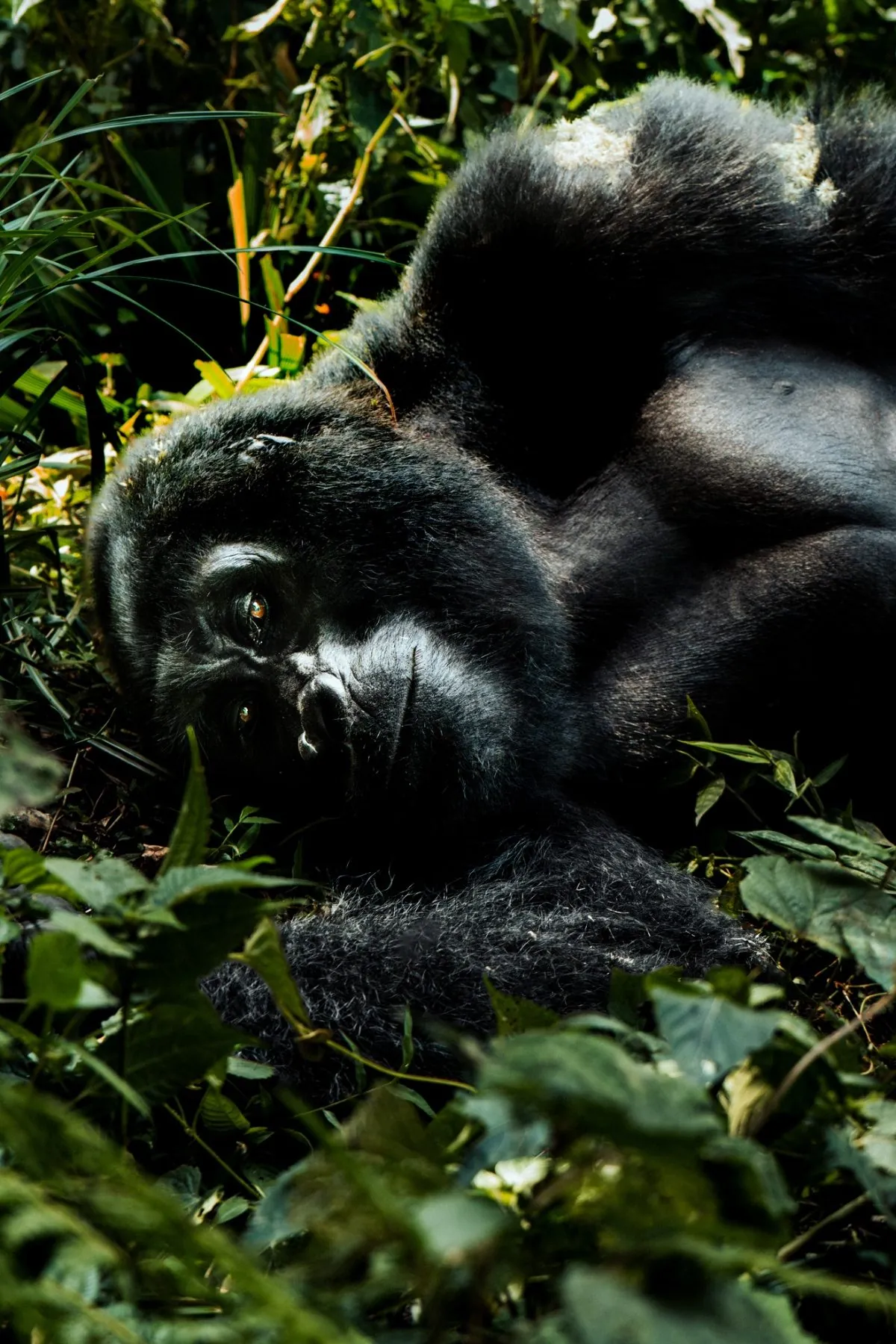
Uganda is home to roughly half the world's remaining mountain gorillas. As of the 2018 population census — the most recent comprehensive survey — approximately 1,063 mountain gorillas survive worldwide, split between Bwindi Impenetrable National Park in Uganda and the Virunga Massif spanning Uganda, Rwanda and the Democratic Republic of Congo. Uganda's Bwindi alone holds approximately 459 individuals (2018 census data; updated figures from the Uganda Wildlife Authority Statistical Abstract 2025 are noted where available). The species was reclassified from Critically Endangered to Endangered by the IUCN in 2018 — the first positive reclassification in the species' recorded history.
Current Mountain Gorilla Population — Numbers and Status
| Location | Population (2018 census) | Notes |
|---|---|---|
| Bwindi Impenetrable National Park, Uganda | ~459 | Sole habitat of the Bwindi gorilla population |
| Virunga Massif (Uganda, Rwanda, DRC) | ~604 | Shared across three national parks |
| Total worldwide | ~1,063 | First time exceeding 1,000 — a conservation milestone |
Info
Exact 2024/2025 population figures for Bwindi are pending publication from the Uganda Bureau of Statistics (UBOS) Statistical Abstract 2025. The 2018 figures remain the most current comprehensive census. [RECHERCHE NOETIG: updated UWA census data 2024/2025]
The IUCN reclassification in 2018 from Critically Endangered to Endangered marked a turning point. It reflects not a relaxation of protection — gorillas remain one of the most threatened primates on Earth — but a measurable recovery from the population lows of the 1980s and 1990s, when fewer than 650 individuals were estimated to remain.
Bwindi Impenetrable National Park — Uganda's Gorilla Stronghold
Bwindi Impenetrable National Park, a UNESCO World Heritage Site in southwestern Uganda, is divided into four trekking sectors: Buhoma in the north, Ruhija in the east, Rushaga in the south, and Nkuringo in the southwest. Each sector has habituated gorilla families — groups that have undergone a multi-year process of gradual human contact, enabling close-range observation. The habituation process typically takes two to three years and is managed by the Uganda Wildlife Authority (UWA) with scientific oversight.
Our team is based in Buhoma, in the Kanungu District, at the northern entrance to the park. During 12 days in October 2024 and further stays in January 2026, we have tracked gorilla families from this sector and observed the depth of ranger knowledge and dedication that makes the programme work. The rangers are not peripheral figures — they are the operational core of gorilla conservation.
Info
Number of habituated gorilla families currently available for trekking across Bwindi's four sectors: [RECHERCHE NOETIG — contact UWA for current figures, as family numbers change as new groups complete habituation]
Learn more about Bwindi's sectors, trails and what to expect on trek:
Bwindi Impenetrable National Park GuideHow a $800 Permit Funds Gorilla Conservation
The Uganda Wildlife Authority charges $800 per person for a gorilla trekking permit (2026 rate, foreign non-residents). This is not simply an entry fee — it is the primary funding mechanism for mountain gorilla conservation in Uganda. UWA allocates permit revenue to ranger salaries, anti-poaching operations, veterinary care for injured or sick gorillas, habitat monitoring and community benefit programmes.
- Ranger salaries and equipment: UWA employs specialised gorilla protection units in each park sector
- Veterinary response teams: mobile units that can intervene when gorillas are snared, injured or ill
- Anti-poaching patrols: systematic monitoring of park boundaries and known snare routes
- Habitat protection: enforcement against illegal logging and encroachment within and around the park
- Community revenue sharing: 20% of non-consumptive wildlife use fees distributed to parishes neighbouring the park (Uganda Wildlife Regulations 2022)
Price Tip
A group of 8 trekkers generates $6,400 in permit revenue in a single morning. Over a year, this funds ranger teams, veterinary care and community projects across all four Bwindi sectors.
From Critically Endangered to Endangered — Why the Population Is Recovering
Mountain gorilla recovery is one of the most documented conservation successes in Africa, and it rests on a specific combination of factors — none of which worked in isolation. Coordinated protection across three countries (Uganda, Rwanda and DRC) created a transboundary conservation corridor that prevented gorillas from being squeezed into isolated pockets. Habituation programmes generated permit revenue that funded the protection itself. Community revenue sharing gave neighbouring populations a direct economic stake in gorilla survival.
The alternative — poaching, agricultural encroachment and unmanaged tourism — had brought the species to the edge of functional extinction by the 1980s. The recovery has been deliberate, data-driven and expensive. It has also been replicated: the Virunga Massif programme and the Bwindi programme operate on compatible frameworks, enabling shared research and coordinated veterinary response.
Threats That Remain — Why Protection Cannot Stop
Reclassification to Endangered does not mean gorillas are safe. The threats that drove their decline have not disappeared — they have been managed. Mountain gorillas face continued pressure from habitat loss around park boundaries, disease transmission from humans (gorillas share approximately 98% of human DNA and are susceptible to respiratory illnesses), and the effects of climate change on forest vegetation and water sources.
- Disease transmission: all trekkers must maintain a 7-metre distance; face masks are required when closer; sick visitors should not trek
- Habitat pressure: population growth in surrounding districts keeps encroachment a live concern
- Climate change: altered rainfall patterns affect forest structure and gorilla ranging behaviour [RECHERCHE NOETIG: UWA climate impact assessments]
- Veterinary access: injured or snared gorillas in remote areas require rapid response to prevent death
What You Can Do as a Traveller
- Book permits through UWA or a licensed operator — every permit generates direct conservation funding
- Follow all trekking rules: maintain 7 metres distance, no flash photography, no eating near gorillas, turn away if you feel ill
- Stay in locally owned lodges that participate in the community revenue-sharing ecosystem
- Choose operators who employ local rangers, guides and staff — the skills and livelihoods built by gorilla tourism stay in the community
- Consider visiting in the low season — spreading permit revenue across more months reduces peak pressure on habituated families
Plan your gorilla trekking with a local operator based in Buhoma:
View Our Gorilla Trekking Safaris