Ecotourism in Uganda is not a marketing label — it is a legal framework. Under the Uganda Wildlife Regulations 2022, 20% of non-consumptive wildlife use fees (including gorilla trekking permits) are redistributed to parishes neighbouring national parks. This is called the revenue-sharing mechanism, and it makes Uganda one of the few countries in the world where tourism revenue is mandated by law to flow to the communities that live alongside wildlife. When you book a gorilla trekking permit, part of that $800 reaches Buhoma — the village at the gate of Bwindi Impenetrable National Park.
The Revenue-Sharing System — How It Works
The Uganda Wildlife Authority (UWA) collects permit fees and park entry charges, then distributes 20% to local governments in the districts surrounding each national park. These funds are earmarked for community development projects — school buildings, health facilities, water infrastructure and small enterprise grants. The Uganda Wildlife Regulations 2022 formalised and updated this mechanism, which has been in place in various forms since the 1990s.
| Fee Type | Revenue Share to Community | Legal Basis |
|---|---|---|
| Gorilla trekking permit ($800) | 20% | Uganda Wildlife Regulations 2022 |
| Park entry fee | 20% | Uganda Wildlife Regulations 2022 |
| Chimpanzee tracking permit | 20% | Uganda Wildlife Regulations 2022 |
Info
Exact distribution figures by parish and project are published annually by UWA. [RECHERCHE NOETIG: current published distribution data for Buhoma/Kanungu District, UWA Annual Reports]
Buhoma — A Community Built Around Conservation Tourism
Buhoma, in the Kanungu District, is the northern gateway to Bwindi Impenetrable National Park and one of the most visible examples of community-embedded ecotourism in Uganda. Over 16 visits to Buhoma — including 12 consecutive days in October 2024 and multiple stays in January and June 2026 — we have watched the community's relationship with tourism evolve from something imposed from outside to something the community shapes and benefits from directly.
On a morning walk through Buhoma in January 2026, we stopped at the Innox and Friends Unique Workshop — a furniture carpentry run by local craftsmen who supply lodges in the area. Fresh wood shavings covered the ground, half-finished chairs and tables stood against the wall, and the owner walked us through his work with evident pride. The supply chain from workshop to lodge table is about 200 metres. That is what local economic integration looks like in practice.
Field Experience
The community does not just live near the park — it has become part of the park's support infrastructure. Porters, rangers, guides, lodge staff, craft makers: the skills and livelihoods built around gorilla tourism belong to Buhoma.
Community Tourism Beyond the Park Gate
Responsible travel in Buhoma extends well beyond the gorilla trek itself. The village has a network of community projects that benefit directly from tourism: cultural walks led by local guides, craft cooperatives, the Nicholas Orphanage which has supported children in the area for years, and the community development fund that receives a share of trekking permit revenues.
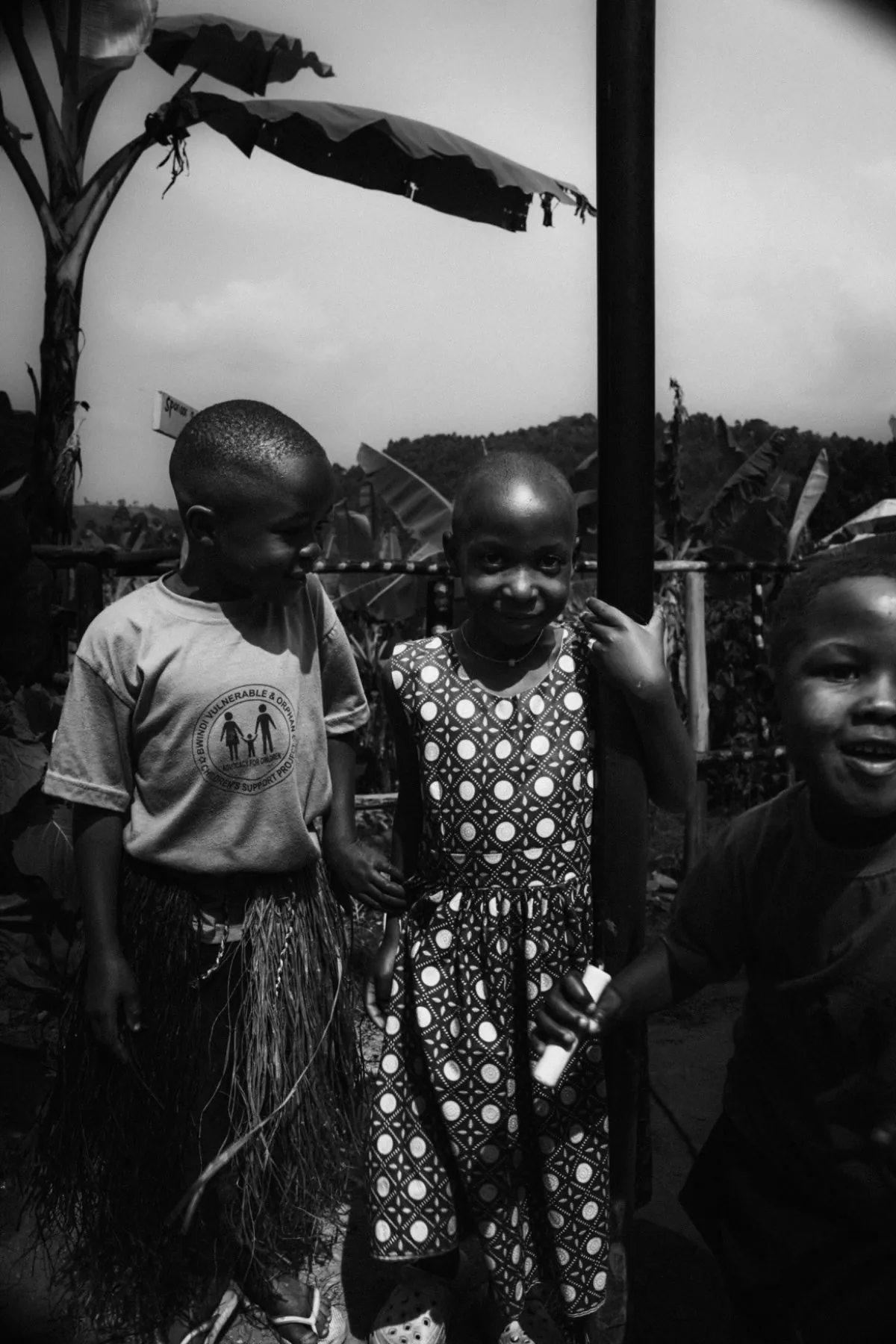
In January 2026, we visited the Nicholas Orphanage in Buhoma with a group of travellers. The children were immediately curious about the camera — there are no mirrors in the building, let alone smartphones, so seeing themselves in a photo was a rare experience. The laughter when a group photo went up on the screen was entirely unplanned. These are the moments that do not appear in any tour brochure, and they are the reason community-embedded tourism produces something qualitatively different from conventional safari travel.
One morning, walking past a group of children on the edge of the road near Buhoma, we saw a ten-year-old boy breaking gravel — a local construction task that supports his family's income. He worked with concentration and without complaint. This is not poverty tourism. It is an honest encounter with a community that navigates real pressures while remaining genuinely welcoming to visitors who approach with respect.
How to Choose Locally Embedded Accommodation
Not all lodges near Uganda's national parks contribute equally to the local economy. The difference between a locally owned guesthouse and an internationally branded lodge is not primarily in comfort — it is in where the money goes. Locally owned properties typically employ staff from the surrounding community, source food from local suppliers, and reinvest profits in the local economy rather than remitting them overseas.
- Ask who owns the lodge — local or Ugandan ownership keeps more revenue in the community
- Look for lodge staff who are from the surrounding village, not shipped in from Kampala
- Choose lodges that source food locally — ask whether they serve Ugandan produce or import everything
- Prefer lodges with established community connections — community walks, craft purchases, local guide employment
- A simple breakfast of rolex (chapati wrap with eggs) and avocado at a Buhoma lodge means local ingredients, local cook, local income
Our recommended lodges near Bwindi, chosen for local ownership and community impact:
Uganda Accommodation GuideThe Practical Guide: 8 Ways to Travel Responsibly in Uganda
- Book gorilla permits through UWA or a licensed local operator — every permit generates direct conservation and community revenue
- Hire a local porter for your gorilla trek — the $15–20 fee supports a community family and helps you on steep terrain
- Stay in locally owned accommodation wherever possible — the accommodation guide linked above provides specific recommendations
- Engage with community tourism activities: craft workshops, village walks, cultural guides
- Tip appropriately — guides, rangers and drivers depend on tips as a significant part of their income
- Do not photograph community members without their consent — ask first, show the result, build a human exchange
- Buy crafts directly from makers rather than from airport souvenir shops — the margin stays local
- Choose a tour operator with demonstrated community ties — ask specifically which community projects they support and how
We arrange safaris that are embedded in the Buhoma community — from locally owned lodges to community walks:
Talk to Our Team in Buhoma