
Murchison Falls National Park is Uganda's largest protected area at 3,877 square kilometres (source: Uganda Wildlife Authority), stretching across the northwest of the country along the Victoria Nile before it flows into Lake Albert. It is one of Uganda's most visited parks — and arguably its most dramatic. The park takes its name from the Murchison Falls themselves, where the entire volume of the Victoria Nile is forced through a gorge just 7 metres wide before crashing 43 metres into the pool below. We visited in October 2024 and came away with footage and photographs that no travel brochure could replicate — and a clear understanding of why this park belongs on every Uganda itinerary.
The Murchison Falls — Why the Nile Makes This Park Unlike Any Other
The Victoria Nile divides Murchison Falls National Park into two distinct halves: a larger southern section where most lodges are concentrated, and a smaller northern section that holds the bulk of the wildlife. A small vehicle ferry at Paraa — the park's tourist hub — connects both banks. Most visitors base themselves south of the Nile and cross to the north for game drives, then take a boat upstream to the Falls themselves.
The boat trip to the foot of the Falls is the single most memorable experience the park offers. The route runs 17 kilometres upstream along the Victoria Nile, with hippos surfacing metres from the boat, Nile crocodiles resting on sandy banks, and elephants drinking from the river's edge. The Falls come into view gradually: first the sound, then the spray, then the sheer spectacle of the entire river compressed into that narrow gorge. [QUOTE: local boat guide on the first time visitors see the Falls]
Info
Boat trips depart from both banks at Paraa. The UWA-operated service (2020 reference price: approx. 30 USD per person) runs daily at 8:00 and 14:00. [RECHERCHE NOETIG: verify current 2026 departure times and prices with UWA]
Wildlife in Murchison Falls National Park — The Numbers
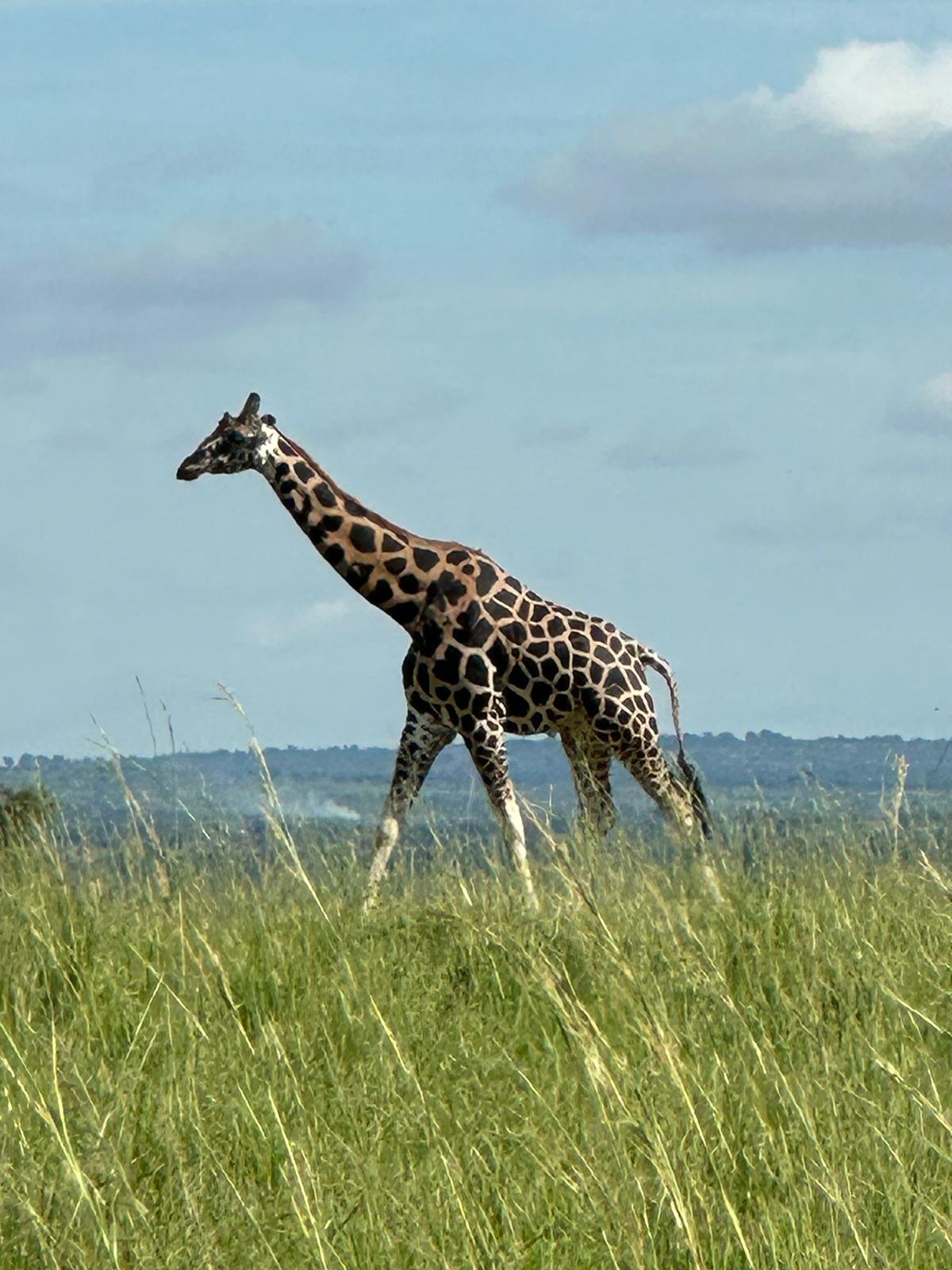
Murchison Falls is home to the largest population of Rothschild's giraffes in the world — approximately 1,000 individuals, making it the single most important conservation site for this endangered subspecies (source: Reiseführer Uganda 2020 / UWA). The park also holds around 1,500 African elephants, primarily concentrated north of the Nile, and an estimated 10,000 Cape buffalo spread across the savanna grasslands (source: UWA). During our October 2024 game drive, we watched a Rothschild's giraffe move with complete unhurried grace through the tall golden grass, utterly indifferent to our vehicle.
| Species | Population (est.) | Best Viewing Area |
|---|---|---|
| Rothschild's giraffe | ~1,000 (world's largest group) | North bank, game drive |
| African elephant | ~1,500 | North bank, north of Nile |
| Cape buffalo | ~10,000 | North bank grasslands |
| Hippopotamus | Large population | Victoria Nile, boat trip |
| Nile crocodile | Abundant | Victoria Nile banks, boat trip |
| Lion | Present | North bank, early morning |
- Six primate species are registered in the park, with the Kaniyo Pabidi Forest in the south holding a habituated chimpanzee population (source: UWA / Reiseführer Uganda 2020)
- The Nile Delta area at the mouth of the Victoria Nile is a world-class birding site — the shoebill stork can be seen here on boat excursions into the delta
- Jackson's hartebeest, Uganda kob, oribi and waterbuck are common on the north bank savanna
- Olive baboon, red-tailed monkey and vervet monkey are regularly spotted along the river margins
Info
The Rothschild's giraffe (Giraffa camelopardalis rothschildi) is among the most endangered giraffe subspecies. Murchison Falls National Park's population represents a globally significant conservation success — the result of decades of UWA protection programmes.
Game Drives — Get Up Before Sunrise
The north bank of the Nile is where game drives happen in Murchison Falls National Park. The grasslands here are open and rolling — nothing like the dense forest of Bwindi — and visibility is exceptional. On the morning of 19 October 2024, we left our lodge well before first light to reach the game drive area for sunrise. The decision was entirely worth it: the light arriving over the savanna, the silhouettes of acacia trees and palms against a deep orange sky, and the quiet before the heat of the day begins is something that stays with you. Wildlife is most active in the first two hours after dawn and in the late afternoon.
Visitors with their own vehicle may drive independently on the north bank. Hiring a ranger from the park headquarters at Paraa costs approximately $20 USD per game drive (2020 reference price — verify current rate with UWA). The ranger adds genuine value: the north bank tracks are often unmarked, and a ranger's knowledge of animal patterns and locations significantly increases sighting quality.
Info
A ranger from Paraa headquarters costs approximately $20 USD per game drive (source: Reiseführer Uganda 2020). [RECHERCHE NOETIG: verify 2026 rate with UWA at the Paraa gate]
The Boat Trip — Two Hours on the Victoria Nile
If the game drive shows you the park from land, the boat trip shows you everything the land conceals. The flat-bottomed boats run close to both banks of the Victoria Nile, and the wildlife density along the water is extraordinary. During our October 2024 boat trip, we watched Nile crocodiles basking on sandbanks — at a respectful distance, but close enough to understand the sheer scale of these animals. They are bigger than most first-time visitors expect, and faster. Elephants came down to the water's edge to drink, entirely unconcerned by the boat.
An alternative boat route runs downstream from Paraa into the Nile Delta — the area where the Victoria Nile meets Lake Albert. Wild Frontiers Nile River Safaris operates a daily departure (approx. 55 USD per person, 2020 reference — verify current price) covering about 5 hours on the water. The delta is the best location in East Africa to reliably observe the shoebill stork, one of the most sought-after birds on the continent, alongside a range of other rare water birds.
Chimpanzee Tracking — Kaniyo Pabidi Forest
The southern section of Murchison Falls National Park contains one of Uganda's quieter chimpanzee tracking sites: the Kaniyo Pabidi Forest. Since 1991, with support from the European Union and the Jane Goodall Institute, six chimpanzee groups have been habituated to human presence. Guided walks of approximately three hours move through flat primary forest of mahogany and ironwood trees up to 500 years old — a completely different ecosystem to the open savanna just kilometres away. Morning departures are recommended as chimps are more easily located by their calls in the early hours. (Source: Reiseführer Uganda 2020)
Getting to Murchison Falls National Park
Murchison Falls National Park lies in northwestern Uganda, roughly 300 kilometres north of Kampala. The main southern entrance at Kichumbanyobo is reached via the Kampala–Masindi highway, passing the Ziwa Rhino Sanctuary approximately 50 kilometres east of Masindi — an excellent stop en route. On 17 October 2024, we made a brief stop at the main park entrance gate. The infrastructure here is newly built — a modern gate complex with clear signage, a proper visitor centre and a freshly laid asphalt approach road. This is a significant improvement from older descriptions of the park's entry points.
On the road north toward the park in October 2024, we passed a minibus carrying a cargo load stacked almost double the vehicle's own height — mattresses, bundles, boxes — all secured with ropes in the impressively pragmatic way Ugandan road transport operates. It is the kind of scene that reminds you that you are genuinely off the tourist trail. This route is well-surfaced and comfortable by Ugandan standards.
- From Kampala via Masindi: approximately 4.5–5.5 hours by road; most visitors stop at Ziwa Rhino Sanctuary (50km east of Masindi) en route
- From Hoima via Butiaba and Buliisa: approximately 4 hours (source: Reiseführer Uganda 2020) — a scenic western approach via Lake Albert
- Domestic flights: charter flights to Pakuba or Bugungu airstrips are available for travellers avoiding the long drive
- Park entry: fees are payable at the gate. Day visitors and overnight guests who do not book activities pay a park entry fee [RECHERCHE NOETIG: verify 2026 UWA entry fee rates]
Where to Stay — North vs South of the Nile
Accommodation in Murchison Falls National Park is split between the north and south banks. The southern section holds the majority of lodges, from budget tented camps through to mid-range safari properties. The northern section has fewer options but positions guests closer to the prime game drive areas — no need for the ferry crossing before your morning drive. Camp sites managed by UWA are available inside the park for independent travellers; the Delta Campsite on the peninsula between the Victoria and Albert Nile is particularly well-located for wildlife viewing, though a ranger escort from Paraa is mandatory there (source: UWA / Reiseführer Uganda 2020).
- Budget: UWA campsite at Delta (approx. $5 USD per person, 2020 reference); camping on grounds of several lodges ($10 per person, 2020 reference)
- Mid-range: Sambiya River Lodge (south bank); Twiga Tales Lodge; Heritage Safari Lodge — prices change seasonally [RECHERCHE NOETIG: verify 2026 prices]
- Upper range: Paraa Safari Lodge (central location for both north and south activities); Chobe Safari Lodge
- Remote north: Bwana Tembo Safari Camp near Pakwach (Italian-run, 4 tents + 6 cottages, full board approx. $210–235 per two persons, 2020 reference); Fort Murchison on the Albert Nile east bank
- Note: park boundaries are unfenced — elephants and hippos may walk through lodge grounds at night
Combining Murchison Falls with Ziwa Rhino Sanctuary
The Ziwa Rhino Sanctuary sits approximately 50 kilometres east of Masindi, directly on the main route between Kampala and Murchison Falls National Park. Almost every visitor to Murchison passes it — and almost every visitor who stops says it was one of the most remarkable encounters of their trip. The sanctuary is the only place in Uganda where white rhinos can be seen in the wild; they were hunted to extinction across the country by the 1980s, and the current population is the result of a decades-long reintroduction programme by the Rhino Fund Uganda. Rhino tracking is done on foot with an armed ranger — the proximity is extraordinary.
On our October 2024 visit, we encountered a single rhino in an open area — alone, grazing steadily, completely unconcerned by our small group. The size of the animal is difficult to convey in photographs. At close range, on foot, a white rhino commands an entirely different quality of attention than wildlife observed from a vehicle. Building a Ziwa stop into the Murchison Falls itinerary adds roughly two hours to the journey but the encounter is irreplaceable.
Info
Current rhino tracking information: www.ziwarhino.com and www.rhinofund.org. The sanctuary lies 8 kilometres from the Nakitoma junction (Kampala–Masindi road), with a signposted western turnoff.
We include Murchison Falls in our 10-day Best of Uganda safari, with Ziwa Rhino stop on the way north:
View Best of Uganda — 10 DaysWant to add Murchison Falls to a custom itinerary? Talk to our team in Buhoma:
Plan a Custom Uganda Safari